
Record to Report (R2R): The Complete Lifecycle Guide
“Learn the six stages of Record to Report (R2R), from recording to reporting, with a bank reconciliation and an intercompany example.”
Expert Perspective
“Record-to-Report (R2R) is a Finance and Accounting (F&A) management process which involves collecting, processing, and delivering relevant, timely, and accurate information used for providing strategic, financial, and operational feedback.”
— FeelFinanced Editorial Board
Record to Report (R2R): The Complete Lifecycle Guide
Picture a leadership team deciding whether to acquire a competitor. Three weeks later they learn that cash was overstated by $4.2 million because some supplier liabilities were never recorded and some intercompany transfers were never reconciled. The figure is hypothetical, but the pattern is real: decisions are only as good as the records behind them.
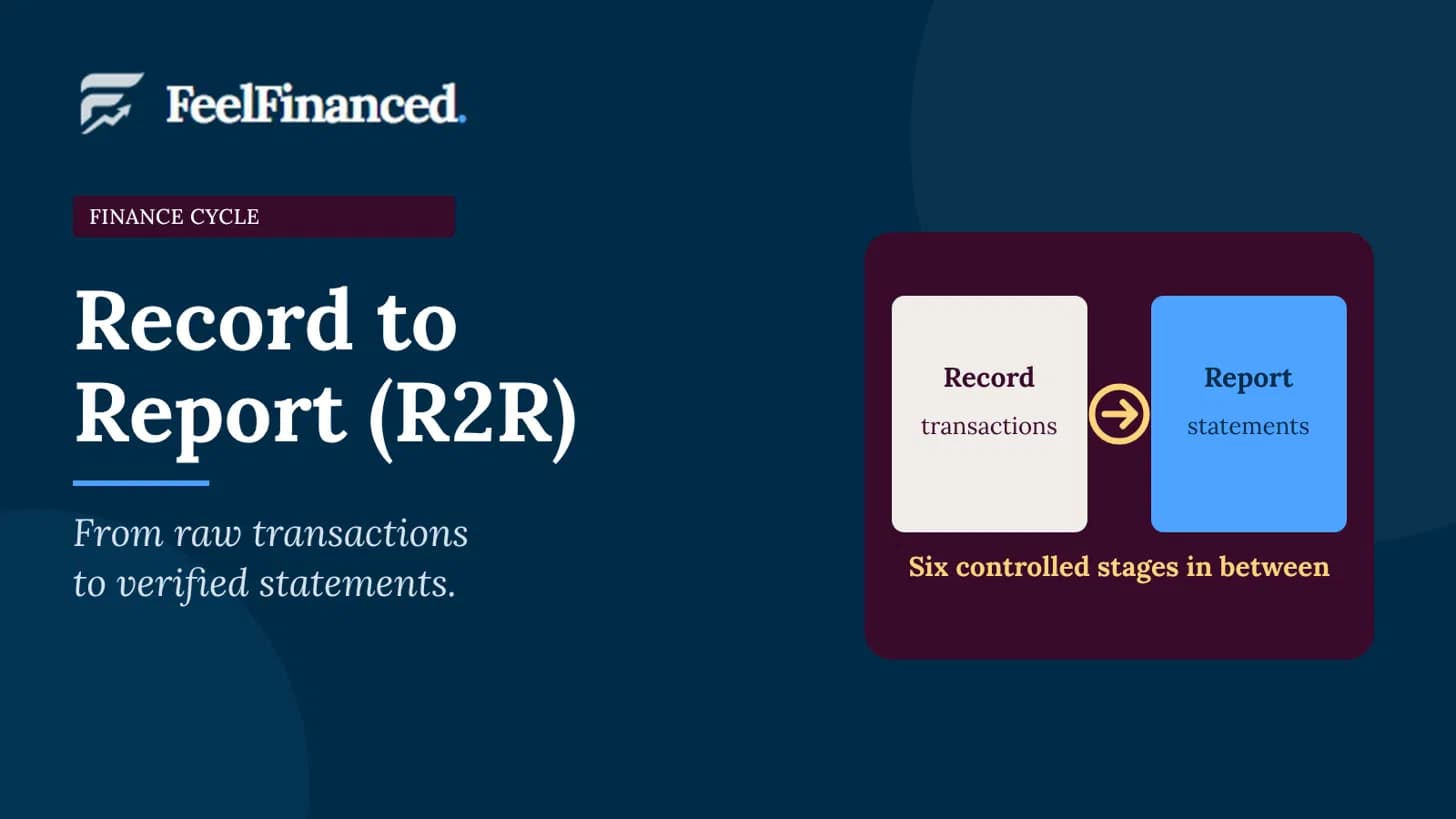
The journey from a raw business transaction to a verified financial statement is called Record to Report (R2R). This guide walks through its stages, the controls at each one, and two worked examples.
Educational note: accounting treatments, close procedures and control frameworks depend on your jurisdiction, structure and reporting standards (IFRS or US GAAP). This is general education, not professional advice.
In one sentence
R2R is the finance and accounting process that captures transactions, maintains the general ledger, reconciles balances, closes the period and publishes financial statements for management and external users.
Why R2R matters
Sales invoices, supplier bills, payroll and depreciation must be turned into standard accounts before anyone can report earnings or judge a capital project. A well-run R2R process:
- Supports compliance. Statements follow the reporting framework in use and the records behind them can be traced.
- Grounds decisions in facts. Management sees margins, cash and debt positions from reconciled numbers, not estimates.
- Strengthens controls. Segregation of duties and regular account reconciliations make errors and misstatements easier to catch.
- Protects trust. Lenders, investors and other users receive consistent information.
Formal R2R teams are most common in multinational groups, shared-services centres, multi-entity retail and e-commerce businesses, and any company with several currencies. Smaller firms do the same work with fewer people.
The six stages of the R2R lifecycle
Companies draw the stages differently. This is one common six-stage model. Stages overlap in practice, but skipping controls early creates problems later.
| Stage | Objective | Typical activities |
|---|---|---|
| Capture transactions accurately | Feeds from purchasing and payables, sales and receivables, fixed assets and payroll; routine journal entries |
| Keep the chart of accounts and postings sound | Manual journals, account coding checks, audit trails |
| Confirm that balances are valid and complete | Compare ledger balances to bank statements and sub-ledgers; resolve differences |
| Finalize and lock the period | Accruals, prepayments, depreciation, intercompany eliminations, locking the ledger |
| Learn from the final numbers | Budget-versus-actual variances, working capital, margin trends |
| Deliver statements | Balance sheet, income statement, cash flow statement, management packs, statutory filings |
A single source of truth
Data often starts in different systems: a billing engine, warehouse software, bank portals. If each feeds its own spreadsheet, teams end up arguing over which number is right. A single source of truth means finance data sits in one structured system, such as an ERP with a shared chart of accounts, so that reports draw on the same figures. It reduces version-control problems; it does not remove the need for review.
Four health metrics to watch
Many finance teams track a small set of indicators. The targets below are illustrative starting points, not standards. Set your own based on your risk and volume.
| Metric | What it shows | Example target |
|---|---|---|
| Upstream data error rate | Coding and master data errors reaching the ledger | Below 1% |
| Auto-matching ratio | Share of bank and sub-ledger lines matched by rules | 80% or more |
| Unresolved discrepancy aging | How long reconciling items stay open | Under 30 days |
| Days to close | Days from period end to sign-off | 3 to 5 business days |
Common challenges and fixes
- Upstream errors (wrong tax codes, missing purchase orders): use input validation in source systems, control master data, and run a mid-month check before close.
- Manual reconciliations: use rule-based matching and reconcile risky or high-volume accounts more often than low-risk ones.
- Intercompany imbalances: agree cut-off dates and exchange rates across entities, and match balances during the month.
- Month-end crunch: spread accruals, bank matching and intercompany work across the month, an approach often called a continuous close.
Worked example 1: a $40,000 cash difference
On day 3 of the close, the general ledger shows cash of $1,450,000 and the bank statement shows $1,410,000. The ledger is $40,000 higher. The report is due in four hours.
Do not post a $40,000 plug to an expense account, and do not escalate without facts. A bank reconciliation separates timing differences from real errors. AccountingCoach explains that deposits in transit are added to the bank balance, outstanding checks are subtracted from it, and unrecorded bank fees are subtracted from the book balance. Only the book side needs journal entries.
Direction matters. Because the ledger is higher, the likely causes are deposits not yet credited by the bank and bank charges not yet booked. Outstanding checks would push the bank balance above the ledger, so they would not explain this gap.
| Amount | |
|---|---|
| Bank statement balance | $1,410,000 |
| Add: deposits in transit | $34,000 |
| Adjusted bank balance | $1,444,000 |
| Ledger balance | $1,450,000 |
| Less: bank charges not yet booked | ($6,000) |
| Adjusted book balance | $1,444,000 |
The two sides agree. The journal entry for the charges is debit Bank Fees Expense $6,000 and credit Cash $6,000. The $34,000 needs no entry, because the bank will credit it soon.
Worked example 2: the $8,000 intercompany gap
Entity A, in the US, bills sister company Entity B, in the UK, $100,000 for development services. A records a receivable of $100,000 and revenue. B's books show a payable of only $92,000, so consolidation is blocked by an $8,000 difference.
Check three things: whether B received the invoice before cut-off, whether exchange rates were applied consistently, and whether B netted a disputed item or tax. Here, B had netted an estimated $8,000 withholding tax against the invoice when it booked the payable.
That is usually not the right place to record it. The invoice is still $100,000, so B should show a $100,000 payable to A. Any withholding is dealt with when payment is made, under the tax rules that apply. B adds $8,000 to the payable and the two entities agree.
At consolidation, the group removes the $100,000 receivable and payable, and the $100,000 of revenue and expense. AccountingTools explains why: a company cannot recognize revenue from sales to itself, so leaving the transaction in would overstate consolidated amounts.
Common misconceptions
"R2R is just bookkeeping." Bookkeeping records transactions. R2R also covers reconciliation, close, consolidation, reporting and analysis.
"Reconciliations can wait for the audit." Errors compound if they sit for months. Regular reconciliations find them while they are small.
"A new ERP automates the close." Systems process what they are given. Without clear procedures and clean source data, an ERP can process errors faster.
Knowledge check
1. A prepaid insurance account has carried a $15,000 unreconciled difference for six months. What is the best first step?
Trace it to the policy contracts, payment records and past amortization schedules. Writing it off without finding the source can hide a recurring error.
2. What is the direct benefit of a continuous close?
Reviews, accruals and reconciliations are spread across the month, so there are fewer period-end bottlenecks.
3. Why must intercompany balances be eliminated on consolidation?
A group cannot earn revenue from or owe money to itself. Keeping internal items in would overstate consolidated revenue, expenses, assets and liabilities. Differences should be resolved before elimination so the entries agree.
Limitations and risks
- Key-person dependency. If one analyst holds the close steps in their head or in a macro, staff turnover can disrupt the close. Write procedures down.
- Over-reliance on spreadsheets. They often lack automatic audit trails and version control, so formula errors can go unseen.
- Jurisdictional differences. A group may need separate local statutory adjustments in addition to group reporting under IFRS or US GAAP.
Remember these five things
- R2R connects daily transactions to reliable statements.
- Fixing errors at the source saves days at close.
- Reconcile regularly and read the direction of every difference.
- Intercompany balances need shared cut-offs, rates and matching.
- Clear procedures matter as much as the software.
This material is for general education. Every situation is different. Consult a qualified professional before making significant decisions.
Disclaimer: This material is for educational purposes only. Every financial situation is unique. Consult with a certified professional before making significant decisions.
About this article
Frequently Asked Questions
More in Record-to-Report (R2R)
Suggested Reading
Accrual Accounting in R2R: Process and Examples
Learn accrual accounting in R2R: the eight-step process, reversing journals, true-ups, accruals versus provisions and best practices for month-end close.
Record-to-Report (R2R)Audit Trail in Finance & Accounting
An audit trail records who changed a financial entry, what changed, when and who approved it. See how it supports internal control with two examples.
Record-to-Report (R2R)Balance Sheet Reconciliation: R2R Guide and Best Practices
Learn balance sheet reconciliation in R2R: six file components, an eight-step process, a bank example and controls that keep reconciliations audit-ready.