
Balance Sheet Reconciliation: R2R Guide and Best Practices
“Learn balance sheet reconciliation in R2R: six file components, an eight-step process, a bank example and controls that keep reconciliations audit-ready.”
Expert Perspective
“Record-to-Report (R2R) is a Finance and Accounting (F&A) management process which involves collecting, processing, and delivering relevant, timely, and accurate information used for providing strategic, financial, and operational feedback.”
— FeelFinanced Editorial Board
Balance Sheet Reconciliation: The Practical Record-to-Report Guide
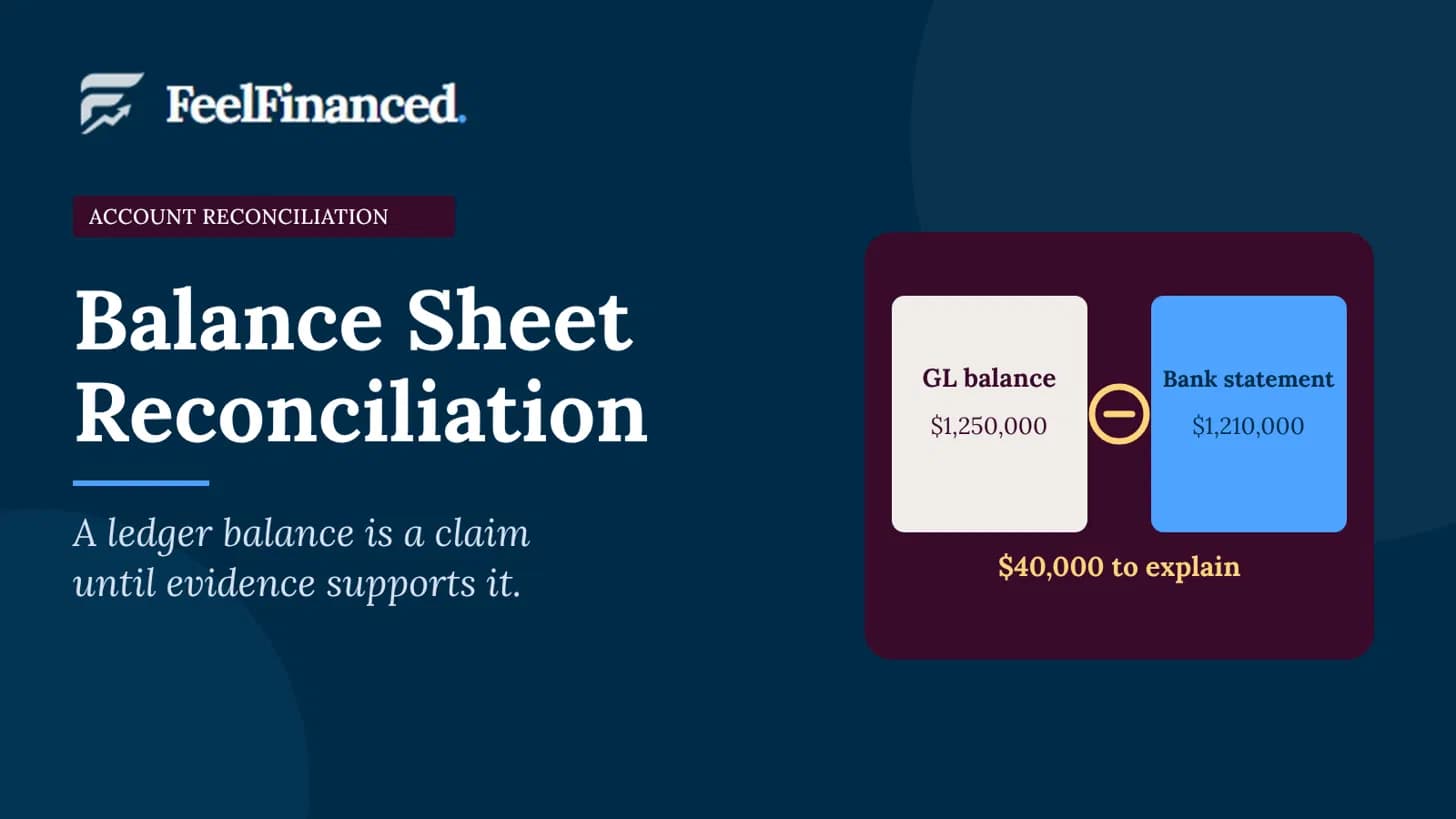
You are two days from closing the fiscal month. The general ledger shows a bank balance of $1,250,000, but the bank statement shows $1,210,000. That $40,000 gap is not a minor variance. It is an unresolved exposure that holds up the close, distorts working capital and invites questions from internal audit. In Record to Report (R2R), balance sheet reconciliation is how raw ledger postings become verified financial statements.
In simple terms
Balance sheet reconciliation verifies that each account balance in the general ledger (GL) agrees to independent evidence: an external statement, a sub-ledger or a formal calculation schedule. AccountingTools defines reconciliation as matching two sets of records to see if there are any differences, and notes that it can lead to adjusting entries that bring the books into line with the supporting evidence.
Why this matters to you
- Fewer close-week fire drills. Finding unreconciled balances early avoids late-night adjustments.
- Better audit readiness. PCAOB AS 2201 requires auditors to evaluate the period-end financial reporting process (paragraph 26), so clean, supported schedules make the conversation easier.
- No hidden leakage. Stale items can conceal unrecorded liabilities, disputed payments or uncollectible receivables.
- Career value. Sub-ledger matching, aging investigation and risk-based prioritization are skills that lead to supervisory roles.
What would you do?
During the Q3 close you are reconciling the intercompany clearing account between Entity Alpha (US) and Entity Beta (UK). Alpha shows a receivable of $240,000. Beta shows a payable of $190,000. A $50,000 difference remains and the deadline is four hours away.
- A. Post a $50,000 plug to miscellaneous expense in Beta to align the balances.
- B. Roll the variance into next quarter without documentation.
- C. Trace the invoice sub-ledger, check whether a transaction was posted by Alpha but delayed in Beta because of cut-off, obtain support and record a valid entry with management approval.
- D. Ask Alpha's billing clerk to reverse the $50,000 invoice.
Answer: C. A plug bypasses controls and disguises real balances (A). An undocumented roll-forward lets errors compound (B). Reversing a genuine invoice falsifies the records (D). Tracing the transaction, confirming cut-off dates and recording an approved entry keeps the audit trail intact.
The framework
Accounts fall into three groups: assets (cash, receivables, inventory, prepaids, property, plant and equipment), liabilities (payables, accrued expenses, short-term debt, deferred revenue, lease liabilities) and equity (share capital, additional paid-in capital, retained earnings).
Six components of every reconciliation file
| Component | What it is |
|---|---|
| GL balance | The starting balance from the ERP at the close cut-off date |
| Supporting balance | The balance proven by third-party or sub-ledger data, such as a bank statement, vendor aging or loan schedule |
| Reconciling items | Itemized differences, categorized by cause |
| Aging analysis | How long each reconciling item has been open, for example 0 to 30, 31 to 60 and over 60 days |
| Adjusting entries | Corrective journals for verified omissions, fees or misclassifications |
| Preparer and reviewer sign-off | Time-stamped approval showing the preparer and reviewer are different people |
The eight-step process
- Extract GL balances from the ERP at the defined cut-off date.
- Collect external records: bank statements, counterparty confirmations, sub-ledger agings, amortization schedules.
- Compare and match transactions, by automated rules or line by line, to find breaks.
- Isolate reconciling items into timing differences, such as unpresented checks and deposits in transit, and permanent errors.
- Investigate root causes with Accounts Payable, Accounts Receivable or Treasury.
- Book adjusting entries for verified items, such as unrecorded fees, interest or reclassifications.
- Assemble the workpaper: opening balances, itemized variances, explanations and attached proof.
- Review and sign off. An authorized manager checks the calculations and evidence.
AccountingTools adds a useful checklist for an account-level review: match the beginning balance to the prior period's ending detail, match period transactions to underlying records, review adjusting entries, confirm that entries due to reverse have reversed, and confirm the ending detail agrees to the balance. It lists three common causes of problems: timing differences, journal mistakes such as flipped debits and credits, and duplicate entries.
Reconciling items: temporary or permanent
AccountingTools defines a reconciling item as a difference between balances from two sources being compared.
| Type | Cause | Examples | Action |
|---|---|---|---|
| Temporary | Timing | Deposits in transit, outstanding checks | Resolve naturally; document and monitor |
| Permanent | Recording errors or omissions | Unrecorded bank fees, interest, a mis-keyed amount | Correcting journal entry |
Worked example: the $40,000 bank difference
A manufacturing unit reconciles its main operating account. The GL shows $1,250,000 and the bank statement $1,210,000, so the books are $40,000 higher than the bank. If left uncorrected, the company risks issuing payments against cash it does not have and overstating an asset.
- Download the statement detail and match it against the GL account.
- Isolate the unmatched items. The bank shows an auto-debit of $15,000 for quarterly loan processing and administration fees and another of $25,000 for payment gateway charges. Neither is in the ledger.
- Verify both against the loan agreement and the merchant processing contract.
- Post the approved entry:
| Entry | Debit ($) | Credit ($) |
|---|---|---|
| Bank fee expense | 15,000 | |
| Merchant processing expense | 25,000 | |
| Cash at bank | 40,000 |
- Refresh the balance. The GL is now $1,210,000, equal to the bank statement, and the variance is zero.
AccountingCoach describes the same pattern: items the company has not yet recorded, such as bank fees, require an adjustment to the balance per books, while outstanding checks and deposits in transit do not. Its examples debit a service charge expense and credit cash.
Lesson: daily bank feeds and automated matching catch automatic charges early and avoid large surprises in the close window.
How often to reconcile
AccountingTools says most accounts should be reconciled monthly, high-risk accounts such as cash may need weekly or daily reconciliation, and low-activity accounts may be reconciled quarterly if monitoring controls are adequate. Adjustments from a reconciliation must be reviewed and approved so the audit trail holds.
Common misconceptions
- "A zero variance means the account is accurate." Offsetting errors can hide problems. A $100,000 customer receipt and a $100,000 supplier payment that are both missing from the books net to a zero cash difference, yet receivables and payables are each overstated by $100,000. Look at the items, not just the net.
- "Reconciliation is a once-a-year task for auditors." It is a monthly control, with high-risk accounts reviewed more often.
- "It is clerical." It takes analysis. You need to understand accruals, revenue recognition, contracts and controls to classify open items.
Knowledge check
1. Prepaid insurance shows $120,000 in the GL, but the policy schedule shows $20,000 has expired and no entry has been posted. What is the correct treatment? Debit insurance expense $20,000 and credit prepaid insurance $20,000. The used portion becomes an expense and the asset shows only unexpired cover.
2. Which condition is a serious reconciliation control weakness? One person preparing, adjusting and approving their own reconciliation with no independent review. Separating preparation from approval is a standard control, though the sources reviewed here do not set it out as a specific rule.
Risks and limits
- Aging build-up. Open items left uninvestigated for long periods can end as forced write-offs. The 60 to 90 day mark is a common practitioner threshold, not a rule from the sources reviewed.
- Spreadsheet fragility. Disconnected workbooks suffer from broken formulas, weak audit trails and version-control errors.
- Cross-border differences. Intercompany balances across countries face exchange-rate and cut-off differences that create recurring imbalances.
- Sub-ledger misalignment. Manual journals posted straight to control accounts without updating the sub-ledger create permanent breaks.
- Framework differences. Accounting treatment can differ between IFRS, US GAAP and local rules, so apply your own policies.
Remember these five things
- A ledger balance is an unverified claim until independent evidence supports it.
- Net zero does not mean clean. Check the individual items.
- Preparer and approver should be different people.
- Track open items by age.
- Reconciling continuously beats the month-end rush.
One-sentence takeaway: Balance sheet reconciliation is the foundational control of the R2R cycle, turning ledger postings into verified, audit-ready financial statements.
This article is for general education and is not individualized accounting, tax or legal advice. Rules vary by jurisdiction and organization.
Sources:
Disclaimer: This material is for educational purposes only. Every financial situation is unique. Consult with a certified professional before making significant decisions.
About this article
Frequently Asked Questions
More in Record-to-Report (R2R)
Suggested Reading
Accrual Accounting in R2R: Process and Examples
Learn accrual accounting in R2R: the eight-step process, reversing journals, true-ups, accruals versus provisions and best practices for month-end close.
Record-to-Report (R2R)Audit Trail in Finance & Accounting
An audit trail records who changed a financial entry, what changed, when and who approved it. See how it supports internal control with two examples.
Record-to-Report (R2R)Month-End Close Process in R2R: Step-by-Step Guide
Follow the 18-step month-end close in R2R: accruals, reconciliations, FX, intercompany, controls and a worked unreversed-accrual example.