
P&L Review and Variance Analysis in Month-End Close
“Salary up 40%? Learn how to investigate before you adjust”
Expert Perspective
“Record-to-Report (R2R) is a Finance and Accounting (F&A) management process which involves collecting, processing, and delivering relevant, timely, and accurate information used for providing strategic, financial, and operational feedback.”
— FeelFinanced Editorial Board
P&L Review and Variance Analysis in Month-End Close
You have just pulled the monthly P&L from the ERP. Employee expense is up 40%, travel has doubled and revenue has fallen. Are these real business movements, wrong entries, missing accruals or late transactions? Answering that question is the job of P&L review and variance analysis, and it is where an R2R accountant moves from posting entries to explaining results.
In simple terms
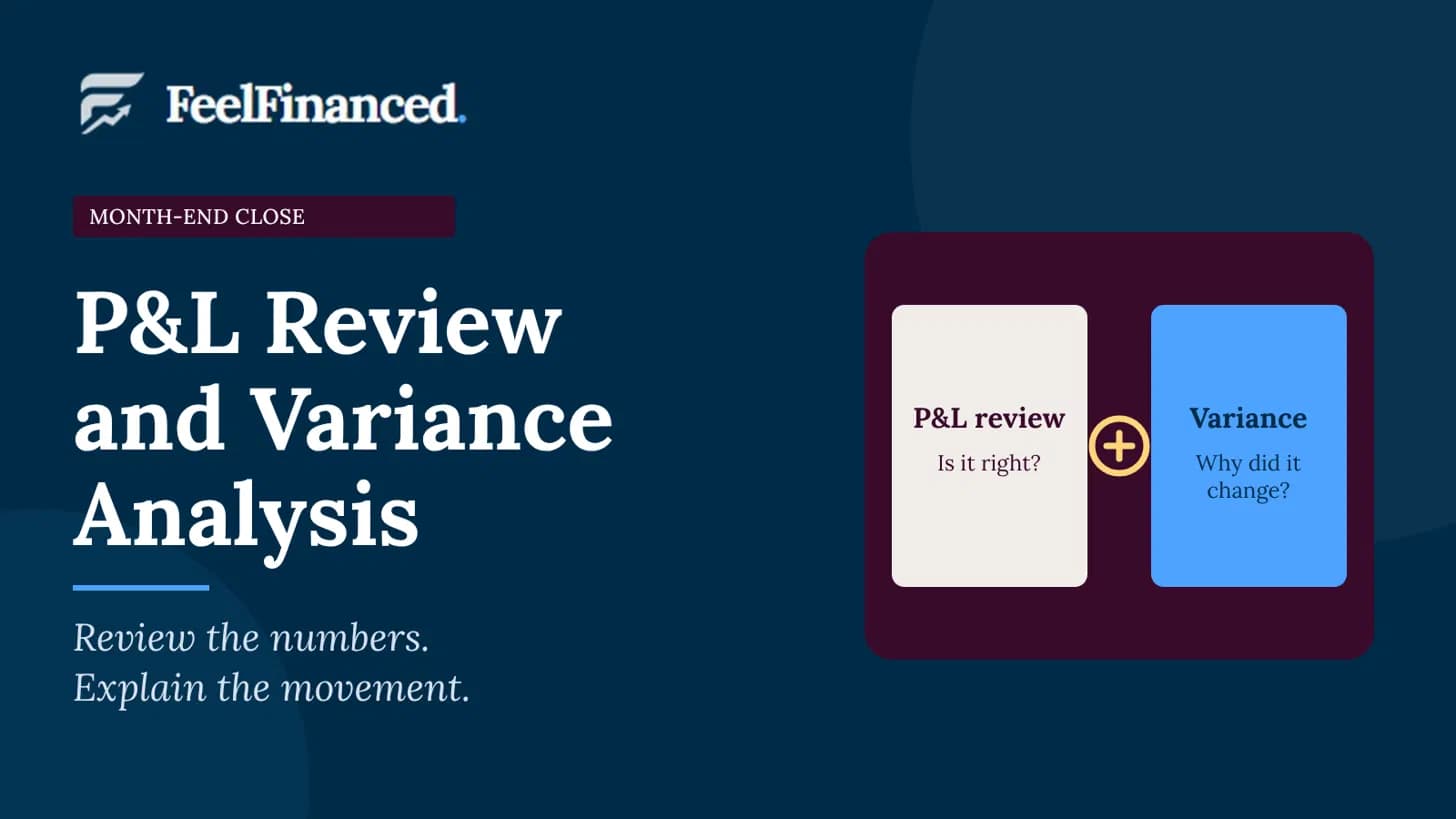
P&L review checks that revenue and expense accounts are accurate, complete, correctly classified and recorded in the right period.
Variance analysis compares figures with another reference point, such as last month, budget or forecast, and explains the differences.
AccountingTools describes variance analysis as the quantitative investigation of the difference between actual and planned results. Put the two together and you can spot errors, validate genuine movements and hand management numbers they can rely on.
Why this matters in R2R
You are not only checking that numbers tie. You are asking whether they make sense. Typical triggers include:
- revenue down while the sales team reports steady activity
- salary cost up after hiring and pay revisions
- rent doubled because a prior-period invoice landed in the current month
- a foreign exchange loss that grew with currency movements
- an expense posted to the wrong account, distorting departmental reporting
Each one needs a different investigation and a different response.
What would you do?
October salary expense is Rs 28 lakh against Rs 20 lakh in September. The 40% rise breaches your investigation threshold. What do you do before finalising the P&L?
- A. Reverse the extra Rs 8 lakh.
- B. Accept it because salaries fluctuate.
- C. Review the payroll register, compare employee data, get confirmation from payroll and validate the records.
- D. Move the extra cost to another account to shrink the variance.
Answer: C. A large movement is not automatically an error, so reversing it (A) could misstate a genuine cost. A threshold breach cannot be waved through (B). Reclassifying without a valid basis (D) adds a second error. Investigate first, then decide whether any adjustment is needed.
The P&L in brief
AccountingCoach explains that the income statement reports revenues, expenses, gains, losses and the resulting net income for an accounting period, such as a month, quarter or year. Unlike the balance sheet, which is a snapshot at a date, it measures performance over time.
| Component | What it shows | Review focus |
|---|---|---|
| Revenue | Income from normal activities | Correct period, supported by documents, no duplicates |
| Cost of goods sold | Direct cost of goods or services delivered | Matches the revenue recognised |
| Gross profit | Revenue less cost of goods sold | Margin moves that volume does not explain |
| Operating expenses | Running costs: salaries, rent, travel, IT | Large movements, wrong accounts, missing invoices |
| Other income and expenses | Interest, exchange differences, disposal gains or losses | Separate presentation per policy |
| Net profit or loss | What remains after all items and tax | Ties to the ledger |
Subtotals such as operating profit depend on your reporting framework and policy. ACCA notes that IFRS 18, which replaces IAS 1, sets defined categories and requires an operating profit subtotal. Check which rules your entity follows before you label a line "operating profit" or "EBIT".
P&L review versus variance analysis
| P&L review | Variance analysis | |
|---|---|---|
| Question | Are the numbers right? | Why did they change? |
| Looks at | Accounts, entries, classification, period | Current figures against another reference |
| Finds | Duplicates, misposts, missing accruals, cut-off errors | Favourable and unfavourable movements |
| Output | Corrected, reliable ledger | Evidence-based explanations for management |
Both are needed. Reviewing without comparing misses unusual swings. Comparing without reviewing explains numbers that may be wrong.
Four comparisons
- Month on month: this month against last month. It shows sudden shifts in revenue, payroll, rent and utilities.
- Year on year: October 2026 against October 2025. It softens seasonality, but you still account for acquisitions, policy changes and restructures.
- Actual against budget: AccountingTools defines a budget variance as the difference between the budgeted or baseline amount and the actual amount.
- Actual against forecast: forecasts are updated as conditions change, so this tells management whether results track current expectations.
AccountingTools also notes that variances are especially effective when viewed on a trend line, so sudden month-to-month changes stand out.
The close process in ten steps
- Finish the close activities. Post accruals, provisions, recurring and one-off journals, depreciation, prepaid adjustments, foreign currency revaluation and reclassifications, and confirm intercompany items.
- Extract the P&L. Verify company code, period, ledger, currency, cost centre and account hierarchy first. A wrong selection gives misleading variances.
- Review revenue. Look for missing or duplicate postings, manual adjustments, cut-off problems and wrong accounts.
- Review expenses. Look for missing invoices, duplicates, odd movements, misclassification and unrecorded liabilities.
- Calculate month-on-month variances using the formulas below.
- Compare with budget and label each variance favourable or unfavourable.
- Investigate significant variances with records, not assumptions. Involve AP, AR, payroll, procurement or business finance as needed.
- Find the root cause and adjust only with a basis. Genuine business movement, or accounting issue? Any correction needs support and approval.
- Document the explanation.
- Validate the final P&L. Confirm entries are posted, large variances explained, corrections approved, the report ties to the ledger and open issues are escalated.
The formulas
{Variance} = {Current month actual} - {Previous month actual}
{Variance%} = {Current} - {Previous}}{{Previous}} x 100
If the previous balance is zero the percentage cannot be calculated, and if it is negative the percentage needs care. Report the absolute movement and the reason instead.
| Account | September | October | Variance | % |
|---|---|---|---|---|
| Revenue | Rs 80 lakh | Rs 100 lakh | +Rs 20 lakh | +25% |
| Salary | Rs 20 lakh | Rs 28 lakh | +Rs 8 lakh | +40% |
| Rent | Rs 5 lakh | Rs 5 lakh | Nil | 0% |
| Travel | Rs 3 lakh | Rs 6 lakh | +Rs 3 lakh | +100% |
Illustrative figures.
Reading budget variances. AccountingTools says a revenue variance is favourable when actual exceeds budget, and an expense variance is favourable when actual is below budget. Context still matters. Higher marketing spend can be justified by an approved product launch. Lower spend is not good news if it hides delayed maintenance or an unrecorded liability. A budget can also be flawed: AccountingTools cites a budget that omitted a rent increase, and notes that a variance can come from an unfilled position rather than good management.
| Account | Budget | Actual | Variance |
|---|---|---|---|
| Revenue | Rs 100 lakh | Rs 110 lakh | Rs 10 lakh favourable |
| Salary | Rs 20 lakh | Rs 28 lakh | Rs 8 lakh unfavourable |
| Marketing | Rs 8 lakh | Rs 6 lakh | Rs 2 lakh favourable |
| Travel | Rs 5 lakh | Rs 8 lakh | Rs 3 lakh unfavourable |
Illustrative figures.
Worked example: the 40% salary variance
September salary was Rs 20 lakh and October Rs 28 lakh, a variance of Rs 8 lakh (40%) over your threshold.
- Pull the account detail and identify the journals behind the extra Rs 8 lakh.
- Ask payroll for the October register, summary and approvals.
- Compare with the employee movement report: joiners, revisions, extra payments.
- Explain the movement.
| Driver | Rs lakh | Share of increase |
|---|---|---|
| New hires | 3 | 37.5% |
| Salary revisions | 2 | 25% |
| Performance bonuses | 3 | 37.5% |
| Total | 8 | 100% |
- Agree the payroll register to the ledger, confirming period and account.
Because payroll records support every rupee, no adjustment is needed. The work product is the commentary:
Employee expenses increased by Rs 8 lakh (40%) compared with the previous month, mainly due to new hires, salary revisions and performance bonuses. The variance was validated against payroll records and approvals. No adjustment is required.
Writing variance commentary
Answer five questions: what changed, by how much, why, whether it is temporary or recurring, and what action was taken. Keep it short enough to read quickly and specific enough to support the conclusion.
Common misconceptions
- "A higher expense means an error." Hiring, expansion, contract changes or one-off items can all explain it. Investigate before you adjust.
- "Variance analysis is only month on month." It also includes year on year, budget and forecast comparisons.
- "Every favourable variance is good." It may reflect delayed maintenance or missing accruals.
- "Only the reporting team reviews the P&L." Responsibility depends on the operating model and often includes GL accountants, controllers and business finance.
- "An ERP report is automatically correct." It reflects the postings, mappings and parameters behind it.
Limits to keep in mind
- Framework. IFRS, US GAAP and local rules differ on recognition, classification and presentation. Apply the one your entity uses.
- Materiality. Set thresholds by materiality, account risk and policy, using absolute and percentage measures. A small unusual item can still signal a control weakness.
- Missing information. Late invoices and payroll files affect completeness. Assess whether an accrual or estimate is needed. AccountingCoach shows the idea with a December utility bill that arrives in January: the cost still belongs to December and is captured through an adjusting entry.
- Budgets. They rest on assumptions, so a variance may say more about the budget than the performance.
- Manual reports. Spreadsheets carry formula and version risk. Use controlled templates and validated extracts.
Habits that help
- Keep a standard review checklist.
- Set thresholds on both amount and percentage.
- Review trends across months, quarters and years.
- Keep invoices, payroll reports, approvals and reconciliations as evidence.
- Agree explanations with AP, AR, payroll and business finance early.
- Use one commentary format.
- Automate repeat extracts and reconciliations, but keep judgement.
- Follow the close calendar and prioritise high-risk accounts.
- Apply maker-checker approval to adjustments.
ERP systems, Excel, Power BI and reconciliation platforms such as BlackLine speed up extraction and comparison. They do not replace understanding the business reason behind a movement.
Why it matters for R2R
A structured review improves reporting accuracy, exposes cost increases, strengthens controls, supports budgeting and forecasting, and leaves documented evidence of how significant movements were validated. That shortens the close and reduces rework.
Knowledge check
1. Travel expense rose from Rs 3 lakh to Rs 6 lakh. What first? Review the transactions and supporting documents. Do not reverse, reclassify or ignore it.
2. Consulting fees are Rs 24 lakh against a Rs 20 lakh budget. What is the variance? Rs 4 lakh unfavourable, because actual expense exceeds budget. Then check the business reason.
Remember these five things
- Make sure the underlying P&L figures are complete before you analyse them.
- Use month-on-month, year-on-year, budget and forecast comparisons together.
- Investigate before you assume an error.
- Document every significant variance with evidence.
- Adjust only with an accounting basis, policy support and approval.
One-sentence takeaway: P&L review and variance analysis make sure every significant movement is understood, supported, correctly recorded and properly reported at close.
Framework-specific treatment of revenue recognition, exchange differences and presentation was not reviewed here. Confirm against the standard your entity applies.
Sources:
Disclaimer: This material is for educational purposes only. Every financial situation is unique. Consult with a certified professional before making significant decisions.
About this article
Frequently Asked Questions
More in Record-to-Report (R2R)
Suggested Reading
Accrual Accounting in R2R: Process and Examples
Learn accrual accounting in R2R: the eight-step process, reversing journals, true-ups, accruals versus provisions and best practices for month-end close.
Record-to-Report (R2R)Audit Trail in Finance & Accounting
An audit trail records who changed a financial entry, what changed, when and who approved it. See how it supports internal control with two examples.
Record-to-Report (R2R)Balance Sheet Reconciliation: R2R Guide and Best Practices
Learn balance sheet reconciliation in R2R: six file components, an eight-step process, a bank example and controls that keep reconciliations audit-ready.