
Month-End Close Process in R2R: Step-by-Step Guide
“Follow the 18-step month-end close in R2R: accruals, reconciliations, FX, intercompany, controls and a worked unreversed-accrual example.”
Expert Perspective
“Record-to-Report (R2R) is a Finance and Accounting (F&A) management process which involves collecting, processing, and delivering relevant, timely, and accurate information used for providing strategic, financial, and operational feedback.”
— FeelFinanced Editorial Board
Month-End Close Process in R2R: A Step-by-Step Guide
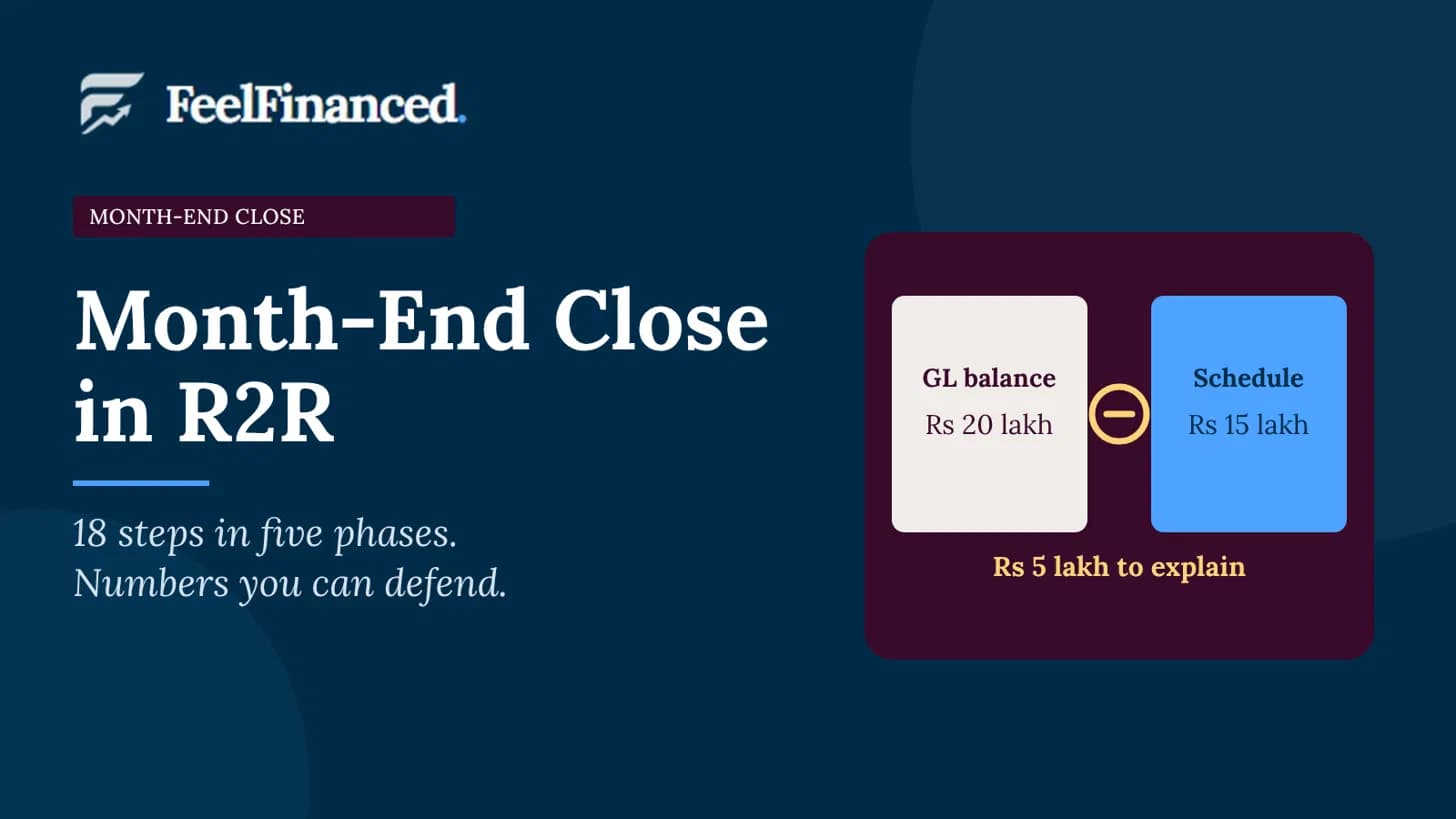
It is the third working day of the month. You open Accrued Expenses and see Rs 20 lakh, up from Rs 8 lakh last month. Nothing looks obviously wrong, but you cannot explain the jump. That is the moment that defines month-end close. The task is not only to finish on time. You must be able to say why every number in the books is what it is.
In simple terms
The month-end close in Record to Report (R2R) is the set of accounting steps a company completes at the end of each period to finalise its records. You confirm transactions are recorded, adjust for what is missing, reconcile balances, review results and lock the period.
Transactions - entries - reconciliation - adjustments - review - reporting - close.
Why this matters to you
The close is where daily work becomes financial statements that managers, auditors and lenders rely on. Errors that slip through become misstated profit, wrong liabilities and uncomfortable audit conversations. For students and career changers, it is one of the most useful processes to learn because it joins journals, reconciliations, intercompany accounting, controls and reporting in one repeating cycle.
What would you do?
During the June close the Accrued Expenses balance is Rs 20 lakh against Rs 8 lakh last month. Your supporting schedule shows only Rs 15 lakh of valid accruals. Your manager wants the reconciliation signed off by end of day.
- A. Sign off because the movement is probably seasonal.
- B. Post a Rs 5 lakh journal to bring the ledger in line with the schedule.
- C. Trace the Rs 5 lakh to its source, assess the impact, get approval for a correction and document the root cause.
- D. Ask AP to explain and wait for their reply before doing anything else.
Answer: C. A reconciliation should explain a balance, not assume it is reasonable (A). A plug entry hides the problem and may leave the cause in place (B). Waiting passively delays the close, and you own the reconciliation (D). Tracing tells you whether the difference is an error or a timing item, what it does to the statements, and how to correct it with approval.
The 18 steps in five phases
Exact steps vary by company, ERP and industry. The overall flow stays similar.
| Phase | Steps |
|---|---|
| 1 Close calendar; 2 Sub-ledger activities |
| 3 GL review; 4 Accruals; 5 Provisions; 6 Journals; 7 FX valuation; 8 Fixed assets |
| 9 Intercompany; 10 Balance sheet reconciliations; 11 Reconciling items |
| 12 Variance analysis; 13 Trial balance; 14 Consolidation; 15 Financial reports |
| 16 Management review; 17 Controls and audit trail; 18 Close the period |
Phase 1: Plan and collect
1. Prepare the close calendar. Set deadlines, owners and dependencies before closing begins. As an illustration only, sub-ledger closure might take one day, accruals and provisions one to two days, bank reconciliation one to two days and intercompany reconciliation two to three days. Your timelines depend on your SLAs and complexity. A good calendar stops one late task from delaying the cycle.
2. Complete sub-ledger activities. The general ledger cannot be finalised until feeder ledgers are complete: payables, receivables, fixed assets, inventory, payroll, treasury, expenses and revenue. Supplier invoices received before month-end but not posted leave expenses and payables understated.
Phase 2: Review and record
3. Review the general ledger. Look for unexpected debit or credit balances, large movements against last month, duplicate postings, manual journals, suspense and clearing accounts, aged balances and wrong classifications. If an expense account that normally shows Rs 10 lakh suddenly shows Rs 50 lakh, investigate. The goal is not to remove every variance but to confirm each balance is reasonable and supported.
4. Record accruals. AccountingTools defines an accrued expense as an expense that has been incurred but has no expenditure documentation yet, recorded by debiting the expense and crediting an accrued expenses liability. If consulting worth Rs 2,00,000 was received in March and invoiced in April, the cost belongs in March:
| Entry | Debit (Rs) | Credit (Rs) |
|---|---|---|
| Consulting expense | 2,00,000 | |
| Accrued expenses | 2,00,000 |
5. Record provisions and other adjustments. These can include bonus and leave provisions, tax and legal provisions, warranty and restructuring provisions, and bad debt provisions. Each needs calculations, assumptions and documentation, and last month's provisions need review for reversal, adjustment or carry-forward under policy.
6. Process recurring and manual journals. Before posting, confirm the correct accounts, amount and period, supporting documents, cost centre or entity, and required approval.
7. Perform foreign currency valuation. For IFRS reporters, IAS 21 says foreign currency monetary items are translated at the closing rate at the end of each reporting period (paragraph 23(a)) and exchange differences on them are generally recognised in profit or loss in the period they arise (paragraph 28). Suppose a USD 10,000 payable was booked at Rs 82 per dollar, Rs 8,20,000, and the period-end rate is Rs 84, making it Rs 8,40,000. The liability rises by Rs 20,000, an exchange loss. The figures are illustrative; US GAAP treatment was not reviewed here.
8. Complete fixed asset accounting. Review additions, disposals, transfers, capitalisation, depreciation, impairment, construction in progress and retirements. Machinery bought in the month that meets your capitalisation criteria is recorded as an asset, not expensed.
Phase 3: Reconcile
9. Reconcile intercompany balances. AccountingTools explains that intercompany eliminations remove transactions between group companies from the group's statements, and that without them sales are grossly overstated. Both entities should record matching entries. Company A debits an intercompany receivable and credits revenue, while Company B debits an expense and credits an intercompany payable. Typical causes of mismatch are timing, different exchange rates, missing invoices, wrong entity codes, wrong amounts and different posting periods.
10. Reconcile balance sheet accounts. Confirm each ledger balance is supported by documents or sub-ledger data: bank, receivables, payables, fixed assets, prepaids, accruals, intercompany, tax, payroll and suspense.
AccountingCoach lists the usual reasons a bank statement and the books differ: outstanding checks, deposits in transit, bank service charges, electronic items not yet recorded, and errors in the books. Outstanding checks and deposits in transit are already in the books and need no entry. Bank charges and unrecorded electronic items do.
Take a ledger bank balance of Rs 25,00,000 against a statement of Rs 24,80,000, a Rs 20,000 gap with the books higher. The direction narrows the causes:
| Cause | Effect on gap | Book entry? |
|---|---|---|
| Bank charges not yet recorded | Books higher than bank | Yes |
| Deposit in transit | Books higher than bank | No |
| Outstanding payment | Bank higher than books | No |
| Unrecorded bank receipt | Bank higher than books | Yes |
So here, unrecorded charges or a deposit in transit are the candidates, and an incorrect journal remains possible.
11. Resolve reconciling items. Finding a difference does not complete a reconciliation. For each item answer: what is it, why did it occur, who owns it, when will it clear and what action is needed. An invoice in the wrong period needs a correcting entry. Unrecorded bank charges need a posting. Watch aged items, because old unresolved balances often point to process or control problems.
Phase 4: Analyse and report
12. Perform variance analysis. Compare month on month or budget against actual to separate normal business movement from potential accounting issues.
13. Review the trial balance. AccountingTools describes it as a report listing the ending balance of every general ledger account, used mainly to check that total debits equal total credits. Equal totals do not prove each balance is right. AccountingTools also recommends agreeing balances to support, reconciling key accounts to subsidiary ledgers and investigating large variances. Review unusual balances, suspense and clearing accounts, intercompany balances and manual adjustments.
14. Perform consolidation. For groups, this follows the individual entity closes: combining entity data, eliminating intercompany transactions, translating foreign statements and recording consolidation adjustments.
15. Prepare financial reports. The core statements are the balance sheet, income statement and cash flow statement. Teams often add actual against budget and forecast, profitability, cost centre reports, dashboards and KPIs.
Phase 5: Review and close
16. Management and controller review. Reviewers focus on significant journals, material movements, reconciliation status, variances, intercompany differences, accruals and provisions, open issues and policy compliance.
17. Close controls and audit trail. Keep evidence of journal approvals, reconciliations, variance analysis, review sign-offs, calculations, intercompany confirmations and exception handling. It should show what was done, by whom, who reviewed it and when.
18. Close the period. Once everything is reviewed, the period is closed in the ERP and later postings are usually restricted or need special authorisation. Before closing, confirm that:
- required journals are posted
- accruals and provisions are complete
- reconciliations are complete
- significant breaks are resolved or documented
- intercompany balances are addressed
- variance analysis and report reviews are done
- controls are performed and approvals obtained
Scenario: the accrual that never reversed
In the June Accrued Expenses reconciliation, the balance is Rs 20 lakh against Rs 8 lakh. Comparing it with the accrual schedule, ledger transactions, prior-month journals and current invoices, you find a Rs 5 lakh accrual from May still in the account. Its invoice was already posted in June. The May entry should have reversed automatically in June but did not, because the journal was created without the reversal setting.
| Item | May | June |
|---|---|---|
| Accrual entry | Dr Consulting expense 5,00,000; Cr Accrued expense 5,00,000 | Should reverse; did not |
| Invoice | Not yet received | Posted as normal |
| Effect | Correct | Expense counted twice; expense and liability each overstated by Rs 5,00,000 |
How to resolve it
- Assess the impact. Document it and escalate under your materiality and escalation policy.
- Correct the error after review and approval: debit Accrued expense and credit Consulting expense Rs 5,00,000. Exact treatment depends on policy and circumstances.
- Re-perform the reconciliation. Confirm the entry posted, the ledger now agrees with the schedule and no duplicate adjustment exists, then submit for review.
- Fix the process. The company had an accrual procedure but no control confirming that accruals needing reversal reversed. Add a monthly check comparing last month's accruals, expected reversals and actual reversal postings.
- Add supporting controls: a standard accrual template, a mandatory reversal-date field, automated validation, reviewer checks before posting, exception reports and ageing analysis.
The Rs 5 lakh mismatch was only the symptom. The real fix is a control that catches unreversed accruals before they reach the balance sheet.
Not every difference is an error. If Entity A records a Rs 10,00,000 intercompany receivable and Entity B a Rs 9,50,000 payable because B posted in July, the Rs 50,000 gap is a timing difference. The teams still document and resolve it under the intercompany policy.
Common challenges and fixes
| Challenge | Practical fix |
|---|---|
| Late transaction posting | Set clear cut-off procedures and accrue material items |
| Many manual journals | Standard templates, approval workflows, automated recurring entries |
| Reconciliation breaks | Clear ownership, root-cause work, ageing tracking |
| Intercompany mismatches | Agree matching procedures and talk to counterparties before the deadline |
| Tight deadlines | Close calendar, defined SLAs, task tracking, daily status checks |
| Poor documentation | Standard support for every significant adjustment |
How technology helps
Technology reduces repetitive work so you can spend time on analysis and judgement. Recurring journals, allocations, depreciation and revaluation can run from approved rules. Workflow can validate account combinations and route approvals. Reconciliation software can match transactions and flag exceptions. Close management tools show who owns delays. Analytics and AI can flag unusual journals, but you make the accounting judgement. Continuous close spreads reconciliations and exception reviews through the month. Automation still needs monitoring, as the scenario shows.
Common misconceptions
- "Closing means hitting the deadline." A fast close with unexplained balances only moves the problem forward.
- "If the ledger and schedule agree, the reconciliation is done." In the scenario both were wrong together.
- "Every difference is an error." Many are timing items that still need documentation.
- "Automation will make the accountant unnecessary." Systems flag; professionals decide.
Knowledge check
1. Entity A shows a Rs 10,00,000 receivable and Entity B a Rs 9,50,000 payable. A posted in June and B in July. What is the Rs 50,000? A timing difference, to be documented and resolved under the intercompany policy. It is not a definite error, an exchange gain or ignorable because it is small.
2. A USD payable was recorded at Rs 82 per dollar and the period-end rate is Rs 84. What happens to its rupee value? It rises, creating an exchange loss. You owe the same dollars, but each costs more rupees.
Limits to keep in mind
- Timelines here are illustrations. Your calendar depends on size, systems, SLAs and reporting duties.
- IFRS, US GAAP and local standards such as Ind AS can treat provisions, foreign currency and consolidation differently.
- Materiality and escalation rules are set by each organisation.
- Quarter-end and year-end closes often add audit adjustments, extra disclosures and subsequent-events review.
- Correcting entries must follow your error-correction policy. Do not post plug entries to force a balance.
Remember these five things
- The close is a structured cycle: collect, record, reconcile, analyse, review and close.
- Complete sub-ledgers and accurate cut-off come before everything else.
- A reconciliation should explain a balance, not just show two numbers agree.
- Find the root cause. A correction without a process fix invites a repeat.
- Documentation, approvals and audit trails are part of the close, not extras.
One-sentence takeaway: A strong month-end close produces numbers you can explain, support and defend, and it improves the process a little each month.
This article is for general education and is not individualised accounting, tax or legal advice. Rules vary by jurisdiction and organisation.
Sources:
Disclaimer: This material is for educational purposes only. Every financial situation is unique. Consult with a certified professional before making significant decisions.
About this article
Frequently Asked Questions
More in Record-to-Report (R2R)
Suggested Reading
Accrual Accounting in R2R: Process and Examples
Learn accrual accounting in R2R: the eight-step process, reversing journals, true-ups, accruals versus provisions and best practices for month-end close.
Record-to-Report (R2R)Audit Trail in Finance & Accounting
An audit trail records who changed a financial entry, what changed, when and who approved it. See how it supports internal control with two examples.
Record-to-Report (R2R)Balance Sheet Reconciliation: R2R Guide and Best Practices
Learn balance sheet reconciliation in R2R: six file components, an eight-step process, a bank example and controls that keep reconciliations audit-ready.