
Fixed Asset Accounting in R2R: Complete GuideFixed Asset Accounting in R2R: Capitalisation, Depreciation and Retirement
“The asset lifecycle from capitalisation and CWIP to depreciation, reconciliation and disposal, with journal entries, controls and KPIs”
Expert Perspective
“Record-to-Report (R2R) is a Finance and Accounting (F&A) management process which involves collecting, processing, and delivering relevant, timely, and accurate information used for providing strategic, financial, and operational feedback.”
— FeelFinanced Editorial Board
Fixed Asset Accounting in R2R: Capitalisation, Depreciation and Retirement
The short answer
Fixed asset accounting records a long-lived asset from approval to disposal. The asset is capitalised at cost, depreciated over its useful life, checked for impairment, reconciled between the asset register and the general ledger, and finally removed with any gain or loss recognised. The entries are simple. The R2R value lies in the controls between them.
Key takeaways
- Capitalise the purchase price and directly attributable costs. Routine maintenance is an expense.
- Depreciation starts when the asset is available for use, so completed projects must leave CWIP promptly.
- Reconcile three things between register and GL: cost, accumulated depreciation and the period charge. Investigate differences before posting any correction.
- At disposal, remove cost and accumulated depreciation, then recognise the difference to proceeds as a gain or loss.
- Depreciation allocates cost. Impairment tests whether the carrying amount is still recoverable. They are separate steps.
Introduction: a machine that is ready on the last day of the month
ABC Manufacturing Ltd. is a fictional company used throughout this article. It buys a machine for ₹800,000, which includes ₹40,000 of installation. It is ready for production on the last day of the month, and a colleague suggests expensing it because the month is almost over. Purchase timing does not decide the answer. The recognition criteria and the capitalisation policy do. Here the machine qualifies, so it is capitalised at ₹800,000 and depreciation starts when it is available for use.
The lifecycle at a glance
| Stage | R2R activity | Key control | Audit evidence |
|---|---|---|---|
| Check the spend is capital in nature | Capex approval; capitalisation policy | Approved request |
| Match invoices to the order | Three-way match; pre-screen invoices | Invoice, order, receipt |
| Build cost; create the asset record | Second-person approval of new assets | Cost schedule |
| Validate parameters; run; review the movement | Maker-checker on master data | Run report, variance note |
| Update location and cost centre | Approved transfer form | Transfer record |
| Register to GL | Signed monthly reconciliation | Reconciliation file |
| Look for indicators | Year-end and event-driven review | Assessment memo |
| Remove asset; recognise gain or loss | Disposal authorisation | Sale or scrap document |
The fixed asset team, procurement, accounts payable and the business all touch this chain. The R2R team usually owns the accounting entries, the reconciliation and the review.
Capitalisation: what goes into cost
The test is what the spend achieves. Spend that creates or improves a long-term asset, and benefits several periods, is capital. Spend that keeps an existing asset running is an expense. A large amount does not make something capital.
IAS 16 defines carrying amount and depreciable amount, and an asset's cost in practice includes its purchase price plus directly attributable costs of getting it ready for use, such as delivery and installation. General overheads and routine maintenance are not automatically capitalisable. Paragraph numbers for the cost elements were not reviewed here (see limitations).
Worked example. ABC Manufacturing Ltd. has an internal threshold of ₹50,000. It buys machinery for ₹500,000 and pays ₹20,000 for routine servicing. The machinery is capitalised. The servicing is expensed.
For the ₹800,000 machine, the purchase price is 760,000 and the installation is 40,000. Cost is 760,000 + 40,000 = ₹800,000.
| Account | Dr (₹) | Cr (₹) |
|---|---|---|
| Machinery | 800,000 | |
| Accounts payable | 800,000 |
The credit is usually a payable. It becomes a bank entry only when the invoice is paid.
Construction in progress (CWIP)
CWIP holds the cost of an asset still being built or prepared. AccountingCoach notes that no depreciation is recorded while the project is under construction, and AccountingTools says the balance moves to the right fixed asset account when the project is complete.
Suppose ABC Manufacturing Ltd. accumulates ₹5,000,000 of qualifying construction cost.
| Stage | Account | Dr (₹) | Cr (₹) |
|---|---|---|---|
| During construction | CWIP | 5,000,000 | |
| Accounts payable or bank | 5,000,000 | ||
| On completion | Building | 5,000,000 | |
| CWIP | 5,000,000 |
The risk sits in the transfer. Depreciation generally starts when the asset is available for use (IAS 16, paragraph 55). A finished project left in CWIP stops the depreciation charge and overstates the asset balance. AccountingTools also advises pre-screening project invoices so that expense items are not parked in CWIP, and splitting CWIP into capitalise and expense sub-accounts.
Review each month: long-outstanding balances, projects completed but not transferred, missing completion certificates and unsupported cost build-up.
Depreciation and asset master data
Depreciation is the systematic allocation of the depreciable amount, cost less residual value, over the useful life (IAS 16, paragraph 6). The method must follow the pattern in which benefits are consumed (paragraph 60). Useful life, residual value and method are reviewed at least at each financial year-end (paragraphs 51 and 61). The monthly process and its common errors are covered in our depreciation article [PLACEHOLDER: link].
Worked example. Cost ₹1,000,000, residual value ₹100,000, five years, straight-line.
- Annual: (1,000,000 − 100,000) ÷ 5 = ₹180,000
- Monthly: 180,000 ÷ 12 = ₹15,000
- Entry: Dr Depreciation expense 15,000, Cr Accumulated depreciation 15,000
Carrying amount equals cost less accumulated depreciation and accumulated impairment losses. With accumulated depreciation of ₹300,000 and an impairment loss of ₹50,000, it is 1,000,000 − 300,000 − 50,000 = ₹650,000.
One wrong field, such as a computer keyed with a ten-year life instead of the approved five, misstates the charge every month. That is why changes to master data need a second approver.
Transfers
Moving an asset between departments, cost centres or locations within one legal entity is an update to the record. It is not a disposal and not a new acquisition. A transfer between legal entities needs more care: the seller derecognises the asset and the buyer recognises it, with intercompany accounting in between. Check your group policy.
Reconciling the register to the general ledger
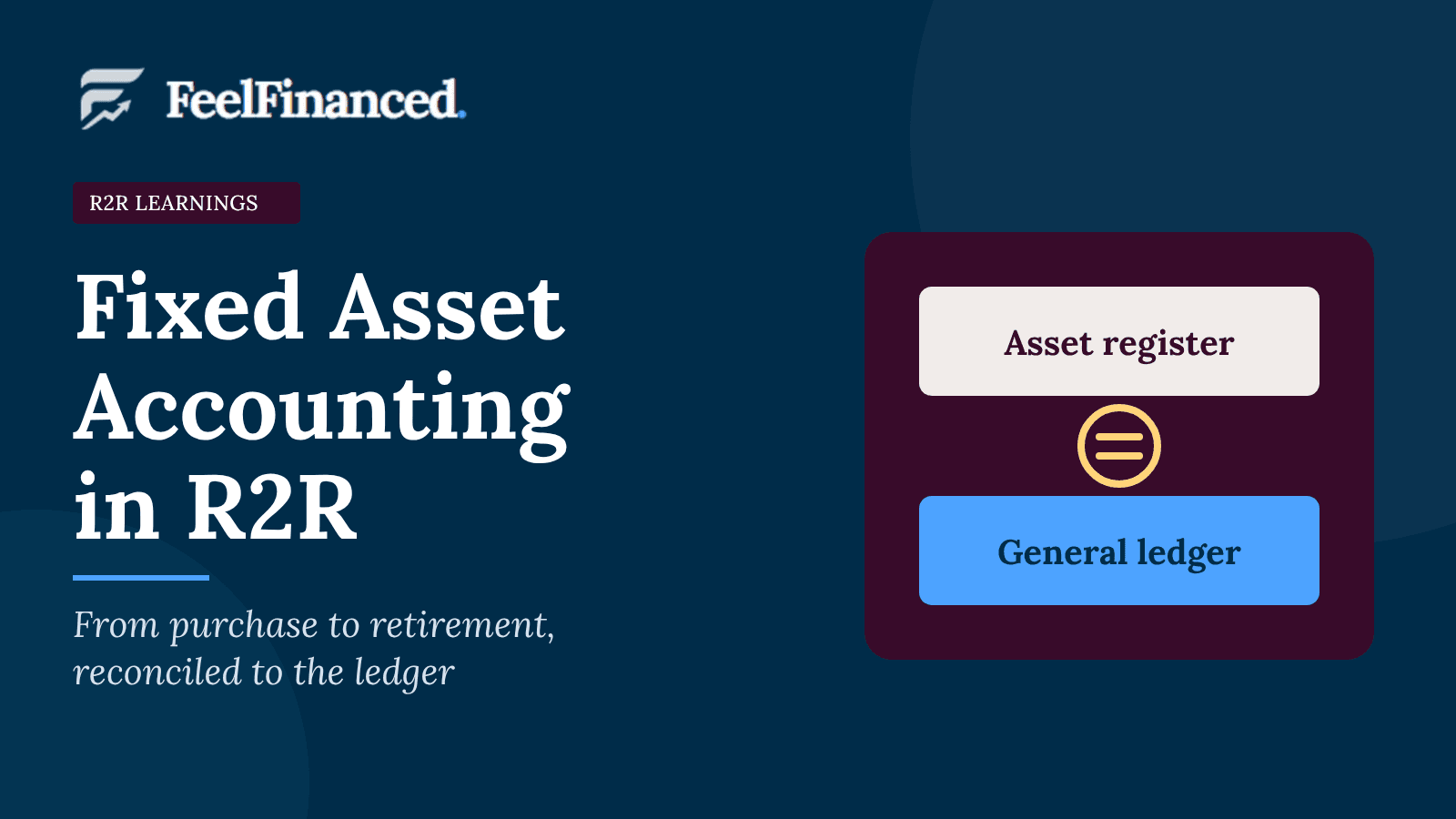
The register holds detail. The GL holds totals. They must agree for gross cost by category, accumulated depreciation, the period depreciation charge, CWIP, disposals and impairment.
Example. The register shows machinery cost of ₹5,000,000 and the GL shows ₹4,950,000. The difference is 5,000,000 − 4,950,000 = ₹50,000.
Do not post a balancing journal yet. Look for a capitalisation that did not reach the GL, a failed interface, a manual journal, wrong account mapping, timing or a duplicate. Post a correction only once the cause is known and approved, and keep the evidence.
A workable sequence: obtain the register report, extract GL balances, compare by category, classify differences, collect support, post approved corrections, obtain reviewer sign-off, file the reconciliation. AccountingTools says the register should agree with the GL but does not set out a reconciliation procedure, so this sequence is good practice, not a requirement.
Disposal and retirement
On disposal, cost and accumulated depreciation leave the books, proceeds are recorded and the difference is a gain or loss (AccountingTools). Under IAS 16 the gain or loss is net disposal proceeds less carrying amount (paragraph 71), goes to profit or loss and is not revenue (paragraph 68). The disposal date is when the buyer obtains control (paragraph 69).
Example. Cost ₹1,000,000, accumulated depreciation ₹700,000, carrying amount ₹300,000. Sold for ₹400,000, the gain is ₹100,000.
| Account | Dr (₹) | Cr (₹) |
|---|---|---|
| Bank | 400,000 | |
| Accumulated depreciation | 700,000 | |
| Machinery | 1,000,000 | |
| Gain on disposal | 100,000 |
Debits 1,100,000 equal credits 1,100,000. Had it sold for ₹200,000, the result would be a ₹100,000 loss, debited in place of the gain credit. Scrapping an asset for nothing writes off any undepreciated balance as a loss (Accounting Tools).
Impairment is a separate test
An asset is impaired when its carrying amount exceeds its recoverable amount. Recoverable amount is the higher of fair value less costs of disposal and value in use (IAS 36, paragraph 6). The entity must assess at each reporting date whether there is any indication of impairment (paragraph 9). Damage or obsolescence are typical triggers. Impairment is an extra reduction. It does not replace depreciation. Leases, investment property, biological assets and assets held for sale sit under other standards, which were not reviewed here.
Scenario: one machine from purchase to sale
ABC Manufacturing Ltd. buys a machine for ₹2,400,000 and spends ₹100,000 on installation. It is available for use on 1 April, with a five-year life, zero residual value and straight-line depreciation.
- Capitalise. 2,400,000 + 100,000 = ₹2,500,000. Dr Machinery 2,500,000, Cr Accounts payable 2,500,000.
- Depreciate. 2,500,000 ÷ 5 = ₹500,000 a year, or ₹41,666.67 a month. Dr Depreciation expense, Cr Accumulated depreciation. Twelve rounded months total 500,000.04, so the final month is adjusted by 0.04.
- Close. Confirm invoices, category, dates, the depreciation run, and that nothing finished remains in CWIP.
- Reconcile. The register shows ₹2,500,000 and the GL shows ₹2,450,000. Find the cause of the ₹50,000 gap before correcting it.
- Dispose. After three full years the machine sells for ₹900,000. Accumulated depreciation is 500,000 × 3 = ₹1,500,000. Carrying amount is 2,500,000 − 1,500,000 = ₹1,000,000. Loss is 1,000,000 − 900,000 = ₹100,000.
| Account | Dr (₹) | Cr (₹) |
|---|---|---|
| Bank | 900,000 | |
| Accumulated depreciation | 1,500,000 | |
| Loss on disposal | 100,000 | |
| Machinery | 2,500,000 |
Debits 2,500,000 equal credits 2,500,000.
Judgement areas
- Whether spend is a repair or an improvement.
- The date a project becomes available for use.
- Useful life, residual value and method, which are estimates.
- Whether an impairment indicator exists.
- Whether a capitalisation threshold is applied consistently. A threshold is a policy tool. Confirm with your auditors how it relates to recognition requirements.
Common mistakes
| Mistake | Effect | Control |
|---|---|---|
| Capital spend expensed, or the reverse | Profit and assets misstated | Policy and invoice review |
| Wrong useful life or category | Charge misstated | Approved asset-class table; second approver |
| Finished project left in CWIP | Missing depreciation; overstated assets | Monthly CWIP review |
| Disposal not processed | Overstated assets; no gain or loss | Disposal sign-off feeds the register |
| Register and GL differ | Misstated balances | Monthly reconciliation with ageing |
| Wrong classification | Misreported depreciation and tracking | Category and mapping review |
| Missing documents | Audit findings | Evidence checklist per transaction |
Controls and good practice
Useful controls include capex approval, a written capitalisation policy, invoice verification, restricted access to master data, segregation of duties, approved transfers, periodic physical verification, regular CWIP review, disposal authorisation, depreciation review, register-to-GL reconciliation and review of manual journals.
Segregation of duties example: one person who can approve capex, create asset records, process disposals and approve the entries can hide an error or misuse. Separate initiation, approval, recording and review where practical.
Accounting Tools describes a controller approving new asset records, which supports the second-approver control. The wider list is good practice. The standards do not prescribe it.
KPIs for the fixed asset process
| KPI | What it shows |
|---|---|
| Unreconciled items | Open register-to-GL differences |
| Ageing of differences | How long they stay open |
| Time to capitalise | Days from available-for-use to capitalisation |
| CWIP ageing | How long project cost sits in CWIP |
| Manual adjustments | Reliance on corrections |
| Disposal turnaround | Time to process a retirement |
| Reconciliations on time | Share completed within the agreed deadline |
| Audit findings | Control and evidence gaps |
These are common management measures, not requirements. Set targets from your own history. No benchmark is implied.
Practical checklist
- New spend assessed as capital or expense against policy
- Cost schedule and invoices agreed
- Asset record approved, with life, residual value, method and start date checked
- CWIP reviewed; finished projects transferred
- Depreciation run reviewed and posted
- Transfers recorded and approved
- Register reconciled to GL for cost, accumulated depreciation and charge
- Differences investigated before correction
- Disposals approved, removed and gain or loss recognised
- Impairment indicators considered
- Evidence filed and reviewer sign-off recorded
What comes next
Suggested related articles (placeholders, not yet published): Depreciation in R2R; month-end close checklist; fixed asset register to GL reconciliation; internal controls over manual journals.
Limitations and jurisdictional considerations
- This article follows IFRS as read from the IFRS Foundation: IAS 16 (earlier review) and IAS 36. The paragraphs on the elements of cost could not be re-read in this session, so cost is described in general terms.
- Ind AS requirements were not checked against an Indian source. US GAAP (FASB Topic 360) was not reviewed. Do not assume the frameworks are identical.
- Significant parts of an asset may need separate depreciation (IAS 16, paragraphs 43 to 47). The examples treat each asset as one component.
- Companies, figures and conventions (full-month charge, zero residual value) are fictional or assumed.
- Tax depreciation, leases, investment property, biological assets and assets held for sale fall outside this article.
Sources and references
- IFRS Foundation, IAS 36 Impairment of Assets
- IFRS Foundation, IAS 16 Property, Plant and Equipment
- AccountingTools, Fixed asset disposal accounting
- AccountingTools, How to record construction-in-progress charges
- AccountingTools, Fixed asset procedures
- AccountingCoach, How do you account for a project under construction?
Disclaimer: This material is for educational purposes only. Every financial situation is unique. Consult with a certified professional before making significant decisions.
About this article
Frequently Asked Questions
More in Record-to-Report (R2R)
Suggested Reading
Accrual Accounting in R2R: Process and Examples
Learn accrual accounting in R2R: the eight-step process, reversing journals, true-ups, accruals versus provisions and best practices for month-end close.
Record-to-Report (R2R)Audit Trail in Finance & Accounting
An audit trail records who changed a financial entry, what changed, when and who approved it. See how it supports internal control with two examples.
Record-to-Report (R2R)Balance Sheet Reconciliation: R2R Guide and Best Practices
Learn balance sheet reconciliation in R2R: six file components, an eight-step process, a bank example and controls that keep reconciliations audit-ready.